1880's Male Fashion Unusual 1880's Women's Fashion

1880s way in the in Western and Western-influenced countries is characterized by the return of the bustle. The long, lean line of the late 1870s was replaced by a total, curvy silhouette with gradually widening shoulders. Fashionable waists were depression and tiny below a full, depression bust supported by a corset. The Rational Apparel Society was founded in 1881 in reaction to the extremes of fashionable corsetry.
Women's fashion [edit]

The fashionable corseted effigy of 1883. Pilus is swept up to the top of the head, and the front hair is frizzled over the forehead.

Princess-line walking apparel (left) and hunting costume (right) from La Mode Illustrée, 1880.
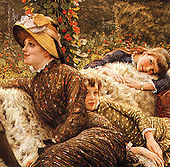
Summertime dresses of 1882 show Aesthetic influence in the small-calibration floral prints. The straw lid frames the fashionable frizzled hair.
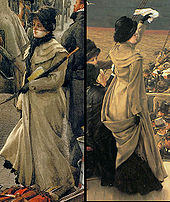
Forepart and back views of a traveling coat, c. 1880–81
Overview [edit]
As in the previous decade, accent remained on the back of the skirt, with fullness gradually ascent from backside the knees to simply below the waist. The fullness in back was balanced by a fuller, lower breast, accomplished by rigid corseting, creating an Southward-shaped silhouette, foreshadowing the more radical form of this shape that would become popular in the early 1900s. These gowns typically did not have a long railroad train in the back, which was dissimilar from the gowns worn in the 1870s, and were extremely tight. They were known every bit the "hobble-skirt" due to the tightness of them. Wintertime gowns were made in darker hues whereas summer ones were fabricated in lighter colors. Velvet was also a very popular fabric used during this menstruum.[1]
Skirts were looped, draped, or tied up in diverse means, and worn over matching or contrasting colored underskirts. The polonaise was a revival style based on a way of the 1780s, with a fitted, cutaway overdress defenseless up and draped over an underskirt. Long, jacket-like fitted bodices called basques were as well popular for clothing during the day.
Evening gowns were sleeveless and depression-necked (except for matrons), and were worn with long over the elbow or shoulder length gloves of fine kidskin or suede.
Choker necklaces and jewelled collars were fashionable nether the influence of Alexandra, Princess of Wales, who wore this style to disguise a scar on her neck.
Underwear [edit]
The bustle returned to style and reached its greatest proportions c. 1886–1888, extending almost straight out from the back waist to support a profusion of drapery, frills, swags, and ribbons. The stylish corset created a low, full bust with picayune separation of the breasts.
A usual type of undergarment was called combinations, a camisole with attached genu- or calf-length drawers, worn under the corset, bustle, and petticoat. Woolen combinations were recommended for wellness, specially when engaging in fashionable sports.
Outerwear [edit]
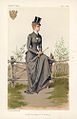
Riding habits had go a "uniform" of matching jacket and skirt worn with a high-collared shirt or chemisette, with a meridian chapeau and veil. They were worn without bustles, but the cutting of the jacket followed the silhouette of the 24-hour interval.
In contrast, hunting costumes were far more than fashionably styled, with draped ankle-length skirts worn with boots or gaiters.
Tailored costumes consisting of a long jacket and brim were worn for travel or walking; these were worn with the bustle and a pocket-size hat or bonnet. Travelers wore long coats like dusters to protect their clothes from dirt, rain, and soot.
Aesthetic clothes [edit]
Artistic or Aesthetic clothes remained an undercurrent in Bohemian circles throughout the 1880s. In reaction to the heavy curtain and rigid corseting of mainstream Paris fashion, aesthetic dress focused on beautiful fabrics made up merely, sometimes loosely fitted or with a belt at the waist. Aesthetic ideas influenced the tea gown, a frothy confection increasingly worn in the dwelling, even to receive visitors.
Hairstyles and headgear [edit]
Hair was usually pulled back at the sides and worn in a low knot or cluster of ringlets; later hair was swept up to the top of the head. Fringe or bangs remained fashionable throughout the decade, ordinarily curled or frizzled over the forehead, oft called "Josephine Curls."
Bonnets resembled hats except for their ribbons tied under the chin; both had curvy brims. Sometimes people wore ribbons too.
Style gallery 1880–1884 [edit]
-

1 – 1880
-

2 – 1881
-

3 – c. 1882
-

four – 1882
-

5 – 1882
-

6 – 1883
-
7 – 1883
-
8 – 1884
- Leona Barel of New Orleans wears a long, fitted jacket with three-quarter-length striped sleeves over a matching striped skirt. A nosegay of flowers is pinned at her waist, c. 1880.
- Sketch of an extremely modish tennis costume.
- Georgiana Burne-Jones wears a princess-line gown trimmed with ruched panels and ruffles, c. 1882
- Baronial 1882 mode plate shows the render of the bustle: the tight overdress is looped upwardly behind.
- Whistler's Portrait of Lady Meux (1881–1882) shows the fashionable full bosom.
- Misses' Polonaise has fitted bodice with a low point in front. The front of the brim is cutaway and the back is looped up after the fashion of the 1780s. It is shown over a gored brim with ruffles. Throughout the century, younger teenage girls ("misses" in mode plates) wore their skirts just higher up their ankles.
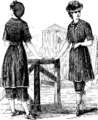
- Bathing dresses of 1883 bear witness fashionable rear fullness.
- The Empress of Austria in a riding habit, 1884. Her habit has the fashionable corseted silhouette, with a simpler skirt suited for riding, alpine shirt collar, and top lid.
Manner gallery 1885–1889 [edit]
-

i – 1885
-

2 – 1885
-

three - c. 1885
-

4 – 1886
-

5 – 1887
-

6 – 1887
-

7 - 1887
-
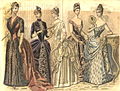
8 – 1888
-
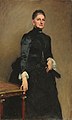
ix – 1888
-
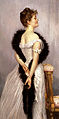
10 – 1889
- Two-piece dress of c. 1885 the "dorsum shelf" bustle. The bodice is draped upward at both sides and worn over a matching underskirt. Los Angeles County Museum of Art, 1000.2007.211.34a-b.
- Madame Paul Poirson wears the fashionable neckline of mid-decade, wide at the bust and narrower at the shoulder. Flowers trim her bodice, pilus, and draped skirt, 1885.
- Pair of embroidered suede boots past F. Pinet, Paris, c. 1885. Los Angeles County Museum of Art, M.58.4a-b
- Outfit which is both strongly influenced by menswear and bustled. Pilus is upswept, with bangs. Elbow-length gloves encounter the shorter sleeves.
- Hairstyle of 1887 is swept upward into a knot, with the front hair curled and frizzled over the forehead.
- Fashions from La Manner Illustrée bear witness dresses made of contrasting fabrics worn with "shelf" bustles and opera-length gloves, 1887.
- Princess Alix of Hesse wears a high-necked day apparel, 1887.
- Fashions of 1888 feature full busts, large "shelf" bustles, and wide shoulders. Gloves reach the elbow or slightly above.
- Eleanora Iselin wears a high-necked black satin costume trimmed with beaded passementerie, 1888.
- Vicomtesse De Montmorand wears an evening gown fastened in back, without a bustle, signalling the styles of the next decade. Her pilus is twisted into a modest knot on elevation of her head and is worn with a curly fringe or bangs, 1889.
Singular loftier-manner [edit]
-
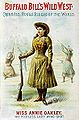
1 – 2nd half of decade
-

2 – 1887
- The 1880s thought of practical women's attire is seen in this affiche showing Annie Oakley wearing shorter skirts and a complete lack of a bustle (adequate for poorer rural frontier women and/or paid public performers).
- Japanese print showing 2 young ladies dressed according to the latest Western fashions of fourth dimension — except that the colors and designs of the fabrics are to Japanese tastes.
Men's fashion [edit]

Engineer Adolphe Alphand wears a topcoat or overcoat with a velvet collar, 1887.
Coats, jackets, and trousers [edit]
Three piece suits, "ditto suits", consisting of a sack coat with matching waistcoat (U.S. vest) and trousers (called in the UK a "lounge suit") continued as an breezy alternative to the contrasting frock coat, waistcoat and trousers.
The cutaway morn coat was even so worn for formal 24-hour interval occasions in Europe and major cities elsewhere, with a dress shirt and an ascot tie. The almost formal evening apparel remained a dark tail coat and trousers with a dark waistcoat. Evening wear was worn with a white bow tie and a shirt with a winged collar.
In mid-decade, a more than relaxed formal coat appeared: the dinner jacket or tuxedo, which featured a shawl collar with silk or satin facings, and ane or two buttons. Dinner jackets were appropriate when "dressing for dinner" at home or at a men's guild.
The Norfolk jacket was popular for shooting and rugged outdoor pursuits. It was made of sturdy tweed or like textile and featured paired box pleats over the chest and back, with a fabric belt.
Full-length trousers were worn for most occasions; tweed or woollen breeches were worn for hunting and other outdoor pursuits.
Knee-length topcoats, often with contrasting velvet or fur collars, and calf-length overcoats were worn in winter.
By the 1880s the majority of the working class, fifty-fifty shepherds, adopted jackets and waistcoats in fustian and corduroy with corduroy trousers, giving up their smock frocks.
Shirts and neckties [edit]
Shirt collars were turned over or pressed into "wings". Clothes shirts had potent fronts, sometimes decorated with shirt studs, and buttoned up the dorsum.
The usual necktie was the four-in-hand and or the newly fashionable Ascot tie, made up equally a neckband with wide wings attached and worn with a stickpin.
Narrow ribbon ties were tied in a bow, and white bowtie was correct with formal evening wear.
Accessories [edit]
As in the 1870s, top hats remained a requirement for upper class formal wear; bowlers and soft felt hats in a variety of shapes were worn for more casual occasions, and flat harbinger boaters were worn for yachting and other nautical pastimes.
Shoes of the 1880s had higher heels and a narrow toe.
Fashion gallery [edit]
-

1 – c. 1880
-
ii – c. 1880
-

3 – 1881
-

four – 1881
-

v – 1882
-

6 – After 1882
-

vii - 1883
-

8 - 1887
- British traveler wears a grey frock glaze and matching trousers with a greyness peak hat, 1880. The coat has two covered buttons at the back waist.
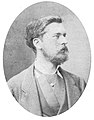
- Painter John Vocalizer Sargent wears a formally pleated Ascot tie. His shirt neckband has softly curled wings, c. 1880.
- Hermann von Helmholtz wears a nighttime coat, waistcoat, and trousers with a stiff-fronted and stiff-collared shirt, High german, 1881.
- Theodor Mommsen wears a narrow necktie tied in a bow with his dark adapt, German, 1881.
- Vanity Fair sketch of agricultural scientist John Bennet Lawes portrays him in walking clothes. His coat with a waist seam and skirts cutaway in a smooth curve is worn with matching trousers and collared waistcoat, 1882.
- George Etiene Cartier wears a dark apron coat, a decorative double-breasted waistcoat, and a narrow bow tie. Montreal, subsequently 1882.
- Lawmen of Dodge Urban center article of clothing their coats with only the high height button fastened. Wyatt Earp (front end row, 2d from left) wears a 3-piece "ditto" suit with contrasting binding effectually the coat collar and lapel, 1883.
- Composer Anton Rubenstein conducts in formal evening article of clothing (night glaze, trousers, and waistcoat, white shirt and necktie), 1887.
Children'due south fashion [edit]
Young girls wore dresses with round collars and sashes. Fashionable dresses had dropped waists. Pinafores were worn for work and play. When going out, especially in the wintertime, girls wore many layers to keep warm. A warm glaze was worn with child leather gloves. Gloves were worn under a muff manus warmer, so when the girl removed her hands from the muff, her gloves would keep them warm. Only like ladies, all upper-class Victorian girls wore gloves when going out. A hat or bonnet was worn every bit well, along with long, knee-length push button-up boots or shorter boots with gaiters to give the appearance of wearing long boots.
Older boys wore knee joint-length breeches and jackets with round-collared shirts.
-

Canada, c. 1880
-

France, 1881
-

1882
-

1882
-

Paris, 1883
-

France, 1885
-

1885–1886
-

Bustled fashions for girls. 1886
-

Boy v years old in brim. 1887
-

Bustled fashions for girls. 1887
-

1887
-

Russia, 1888
Working clothes [edit]
-

Freeholders of Ruokolahti, Finland, 1882
-

French reapers, 1886
-
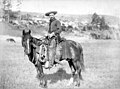
Cowboy, c. 1888, South Dakota
Run into as well [edit]
- Victorian fashion
- Victorian apparel reform
- Creative Dress motility
- Corset controversy
- Svenska drägtreformföreningen
References [edit]
- ^ Warren, Geoffry (1987). Fashion Accessories Since 1500. London: Unwin Hyman. pp. 121–122.
- Arnold, Janet: Patterns of Fashion two: Englishwomen's Dresses and Their Structure C.1860–1940, Wace 1966, Macmillan 1972. Revised metric edition, Drama Books 1977. ISBN 0-89676-027-8
- Ashelford, Jane: The Fine art of Apparel: Clothing and Social club 1500–1914, Abrams, 1996. ISBN 0-8109-6317-v
- Blackness, J. Anderson and Madge Garland: A History of Fashion, Morrow, 1975. ISBN 0-688-02893-4
- Nunn, Joan: Fashion in Costume, 1200–2000, 2d edition, A & C Black (Publishers) Ltd; Chicago: New Amsterdam Books, 2000. (Excerpts online at The Victorian Spider web)
- Payne, Blanche: History of Costume from the Ancient Egyptians to the Twentieth Century, Harper & Row, 1965. No ISBN for this edition; ASIN B0006BMNFS
External links [edit]
- 1880s Fashion Plates of men, women, and children's way from The Metropolitan Museum of Art Libraries
- 1880s Fashion
- From Reforming Way, 1850-1914: Politics, Health, and Art, Ohio State University :
- Olive wool tea gown, 1882
- Bustle, corset and combination, 1884-1890
- Navy wool tea gown c. 1889
- What Victorians Wore: An Overview of Victorian Costume
- "19th Century Women's Fashion". Fashion, Jewellery & Accessories. Victoria and Albert Museum. Retrieved 2007-12-09 .
- Children's fashion of the 1880s
0 Response to "1880's Male Fashion Unusual 1880's Women's Fashion"
Post a Comment