Ancient Jewish Fashion in the Time of David
Dress in the ancient world
What did they wear? Bible Study Resource
Over many centuries the Jews, and the early Christians as well, borrowed way from all the peoples around them. There were many influences, considering they had been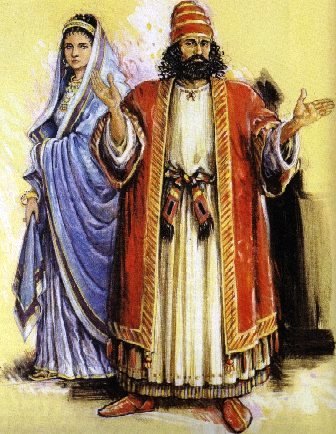
- exiles in Arab republic of egypt and Babylonia
- ruled by Greeks and Romans
- lived in a state which was a natural crossroads between major cultures of the ancient world
- exposed to the fashion of apparel of the Syrians, the Canaanites and Phoenicians, the Assyrians and Babylonians, the Greeks and the Romans.
What a mix!
Materials and textiles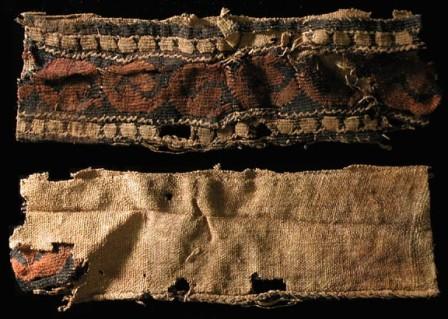
What did they have to work with?
In biblical times the basic textiles were wool and linen. Both could be spun rough or fine.
Commencement, make your linen
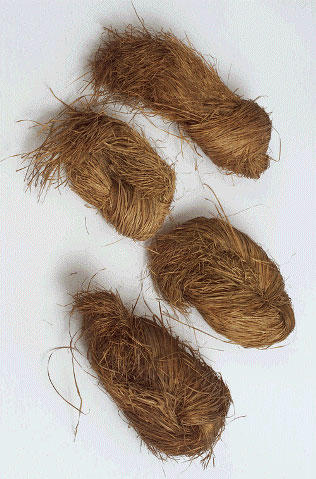
Twisted hanks of flax fibre, late Middle Kingdom, nearly 1850-1750 BC
You could not, of class, become to a shop and buy cloth. You lot had to brand your ain.
Linen was favored, but making linen out of flax is quite a process. First the outer bark of the stems is removed (later on it has rotted) and the fibres separated. Egyptian tablets show the flax being pressed into tubs of water, and Josiah ii:six refers to the fibres spread out in the sun to dry.
At right are some twisted hanks of flax fibre, probably late Eye Kingdom, about 1850-1750 BC. Non much to look at, only fibre like this fabricated linen that was sought all over the aboriginal world.
The long fibres were spun into thread and wound onto a spindle held in the hand. The spindle was spun round in the fingers to tighten and strengthen the thread and, to keep this even, a heavy weight known every bit a 'whorl' was attached to 1 end.
The whorls were made of clay or stone, and the large number of them plant in virtually all excavations is bear witness of the universal practice of the arts and crafts.
It was carried on by women (as described in Proverbs 31:19) rather than by tradesmen, whereas weaving was a merchandise.
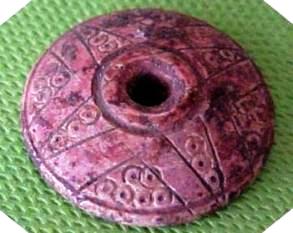
Mesopotamian whorl
Weaving cloth
The threads were woven into cloth on a loom made from a long beam supported by posts or in some other way.
- The warp threads were hung from this beam, weighted down past stones or other loom weights to continue them steady.
- The weaver threw his shuttle, carrying the long weft thread, backwards and forrad between the warp to make the cloth.
The biblical loom was upright, not horizontal, and the weaving was done from the top downwards.
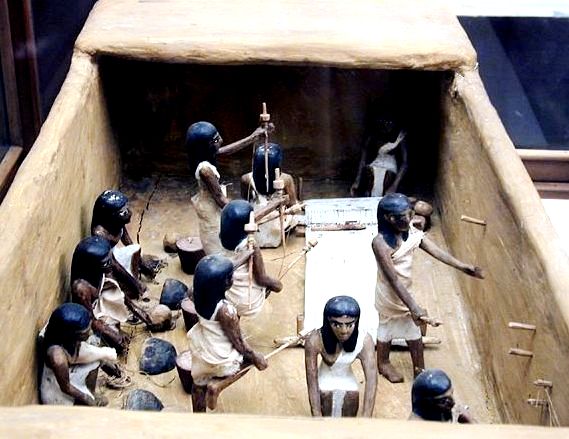
Model of a weaver'southward workshop with eleven workers, Cairo Museum
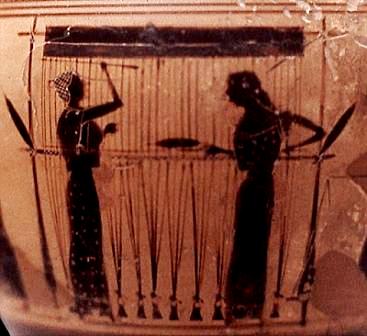
Illustration on a Greek vase, showing women working at a loom
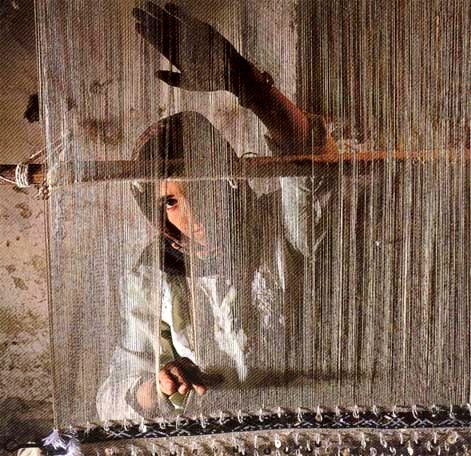
A immature Middle Eastern girl sits at a loom, weaving.
Little has changed since ancient times.
When the piece of cloth was finished, the ends of the threads were knotted into fringes to preclude unravelling.
After all his tedious work, the weaver was naturally reluctant to see the cloth cut. Instead of making fitted garments, the rectangular slice of cloth would usually be draped around the torso, fringes and all.
The Egyptians excelled in making fine linen, often dyeing the threads to weave coloured or patterned material, or embroidering the finished goods.
The Hebrews must have learned some of these skills because later on they were able to build the tabernacle with 'bluish and purple and carmine and fine twined linen, wrought with needlework' (Exodus 26:1).
In early days, the yarn was dyed in cold vats, like those of the installation at Debir (below), which dates from the 8th-6th centuries BC. In the post-Exilic period, hot vats were used for dyeing woven cloth, every bit was customary outside Palestine.

Vats for dying cloth, found at aboriginal Debir
Dissimilar types of garments
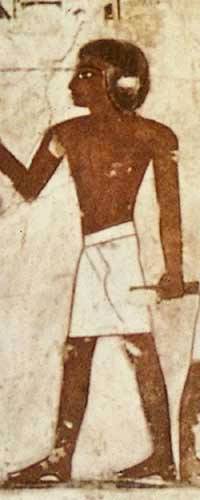
Egyptian wall painting of a young man dressed in the kiltlike loincloth called the ezor. Many Egyptian paintings bear witness such a garment wrapped around the loins and tied with a chugalug or girdle
The earliest undergarment was probably the kiltlike loincloth worn next to the skin, called ezor (Two Kings i:8; Matthew 3:4). Many Egyptian paintings testify such a garment wrapped around the loins and tied with a belt or girdle (hagorah), and Matthew describes John the Baptist wearing clothing like this.
For religious functions, a shirt or apron was tied around the body (I Samuel two:xviii; II Samuel half-dozen:14).
In full general, the nearly common garment was the tunic, the ketonet, chiton, or tunica (John 19:23).
This tunic or outer garment was made by merely folding a rectangle of material in one-half and sewing up the sides, leaving openings for the head and arms. This could be worn open or closed, with or without sleeves, depending on the people or place.
The about usual Hebrew term for a peak garment, mayhap worn over the tunic, is the me'il, although in many cases English versions wrongly translate the term 'coat' (encounter Joseph's coat). Apparently it was besides worn by people of high rank.
Such a costume is pictured in a borderstone of a Babylonian male monarch (circa 1100 BC) although this one was collarless and had brusk sleeves ending above the elbows. After on, prove from the New Attestation (Mark 6:9; Luke three:11) suggests that at times people wore two coats.
The Cloak/Simlah
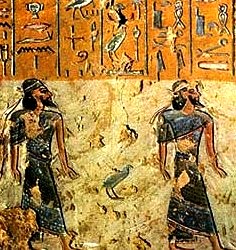
Tile from Medinet Habu showing a garment that seems to exist wound several times effectually the trunk
In Old Testament times, most people – men and women – wore a shawl or cloak made of wool or linen draped fairly closely around the body over the tunic.
Jewish law (Deuteronomy. 22:five) makes it articulate that women's clothing differed from men's.
The saddin may have been like to the outer cloak (simlah) that was worn, for instance, by King Jehu and his attendants bringing offerings to Rex Shalmaneser, shown in the black obelisk of Shalmaneser.
See this image at Habiliment: the testify.
What did they wear on their heads?
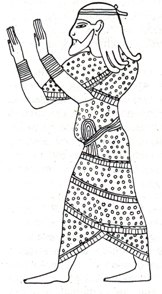
Drawing of one of the tiles from Medinet Habu
The Bible tells how fine linen was wrapped around the caput of the Loftier Priest every bit a turban or mitre — the saniph or kidaris (Exodus 28:39).
Ordinary people wore a kerchief over the head, held tight by a cord reminiscent of the Arab headdress usually worn today, the 'aggal.
When bareheaded, men wore a fillet to continue their long pilus in place (see right, drawing of one of the tiles from Medinet Habu).
A skull cap or turban was also typical. The peasant or soldier only wound a simple strip of cloth around the caput, leaving one fringed cease to hang over the right ear.
Did they habiliment shoes?
In aboriginal times men mostly went barefoot indoors only outside they protected their feet with a sandal commonly fabricated of a elementary sole of untanned leather, tied on with straps or latchets (Genesis 14:23; Marker 1:7).
A sandal was the cheapest thing one could imagine (Amos 2:6) — only the shoe-strap was worth less (Genesis 14:23).
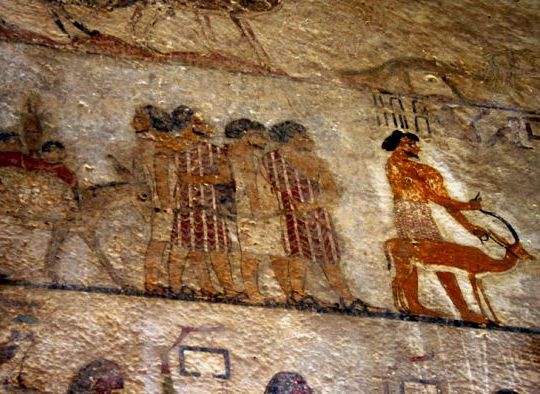
Egyptian Beni Hassan painting shows men wearing thonged sandals
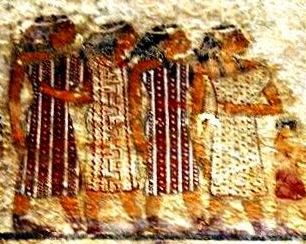
The Egyptian Beni Hassan painting shows women wearing soft low boots
The Egyptian Beni Hassan paintings in a higher place show men wearing thonged sandals, while the women have soft low boots of a kind withal constitute in western Asia a few decades ago.
In the black obelisk of Shalmaneser shown below, tribute bearers bringing costly gifts to the Assyrian ruler announced to exist shoeless or wearing calorie-free shoes. Shoes had to be removed in sure circumstances, for example in the presence of a male monarch or ruler.
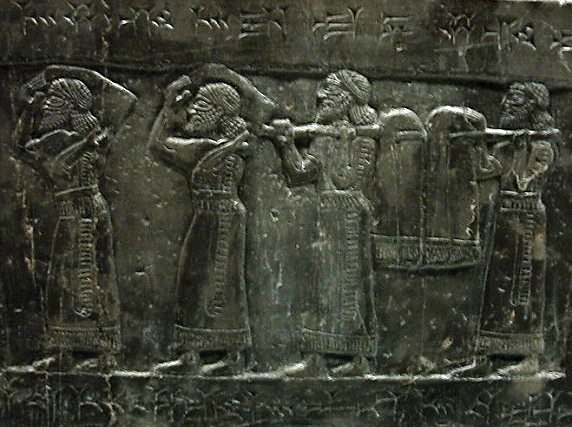
Obelisk of Shalmaneser with tribute bearers bringing gifts for the king.
In later times a much greater elegance was accomplished. A good instance of second century AD footwear in Israel is the child'south sandal found, with its straps still intact, in a cave of Nahal Hever, terminal hideout of Bar-Kochba's partisans. The other sandals were worn past adults.
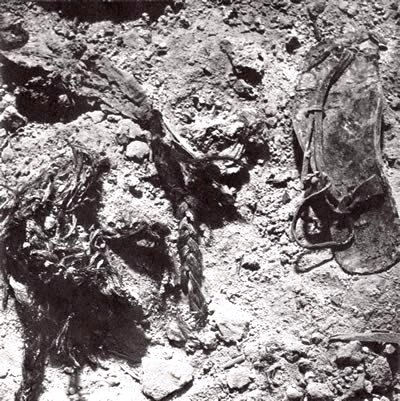
Above: The sandals, with homo hair,
at the excavation site at Nahal Hever
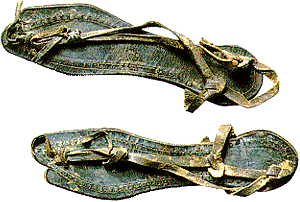
Unproblematic strap sandals plant in a cavern of Nahal Hever
In the same cave, pieces of leather which had once formed role of a garment or bag (run across below) were as well plant, and nearby were two samples of sewn leather which had once belonged to an outer glaze.
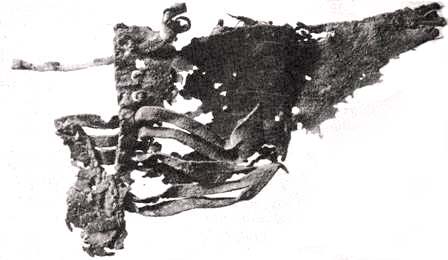
Remnants of a leather woven pocketbook found in the caves at Masada; information technology must take belonged to the people who took refuge in a cliff-face cavern immediately before
the Roman legions bankrupt through
Decoration: tassels and fringes
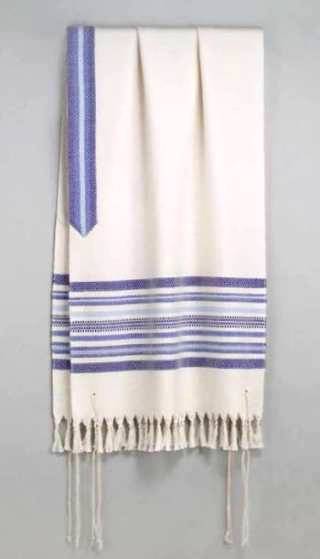
The tallit
Jewish people were required by their law (Numbers xv:37-41; Deut. 22:12) to put tassels (tzitzit or fringes) on the corners of their garments with a blue string intertwined in them. This tradition is nevertheless followed past observant Jews during services, in the tasselled tzitzit knotted on the iv corners of the tallit, a big fringed, four-cornered prayer shawl.
The big tallit, usually fabricated of wool, was worn only during morning time prayer and in the afternoon and for all services on the Day of Atonement.
All the same, a special undergarment, the "arba kanfot" (4 corners) or "tallit Utan" (small tallit), was worn perpetually during waking hours under the outer garment.
The blue dye for tzitzit was obtained from the Mediterranean body of water snail (murex) from which the ancients (mainly the Phoenicians) obtained blue and purple dyes. Because the use of shellfish gave rising to certain difficulties, the Talmud (Menahot 38a) later on taught that all fringes might be white.
Every male garment originally had tzitzits and wearing them differentiated a zealous Jew from his neighbours. Afterwards on, however, they were worn simply on intimate garments or in the synagogue.
Clothes in the tardily Bronze and early Fe Ages(1300-930 BC)
The Canaanite ivory carvings of Megiddo (12th century BC) evidence the men wearing long sleeved robes over a coloured tunic (ketonet), embroidered in geometric designs. Over their robes the simlah is wrapped closely around the body, leaving the correct shoulder and arm complimentary. On their heads, they take close-fitting caps.
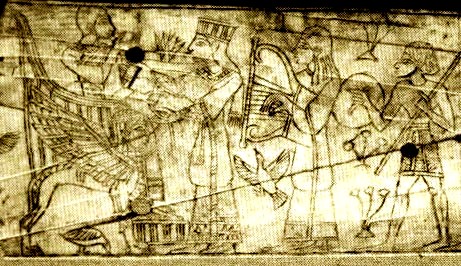
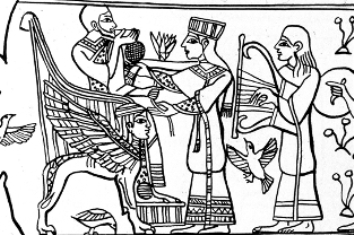
Part of an ivory carving found in the ruins of ancient Megiddo
The women are besides dressed in long robes (simlah), trimmed at the neck.
- Some of the ivories show women in sleeveless dresses, some with loose sleeves, showing the long sleeves of the undertunic (ketonet).
- Some are worn open in the front, decorated with embroidery all effectually the edges, and with long tassels hanging downward in front.
- One woman (meet above) wears a wide, apartment-topped headdress like a crown, over a kerchief.
- In contrast, the harpist is blank-headed, with her hair spread over her shoulders. She may exist a "kedeshah" or temple-priestess.
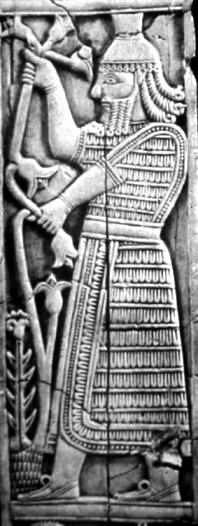
Shalmaneser ivory
An Assyrian law stipulated that a respectable married woman must cover her head, while an unmarried daughter must go bareheaded.
The carvings in a higher place and at correct present a court and/or religious scene, so information technology may non be a good indication of ordinary Israelite costume of the menses. It does show, however, that Fe Age garments were no longer attached past means of pins, but made use of fibulae or buckles.
Late Atomic number 26 Age (930-600 BC)
The black obelisk of Shamaneser 3 (run into Apparel: the evidence) shows the Assyrian king receiving tribute from Jehu, rex of Israel.
- Some of the Assyrians wear fillets on their pilus, flat sandals and long, short-sleeved robes with fringes at the lesser, tied with a tasselled sash.
- Others are wearing a long skirt with fringed shawls wrapped effectually the shoulders and waist.
- The Assyrian king wears a fez-like cap on his head.
- The Israelites wear a long brim or tunic — very little different from what was worn at the starting time of the Israelite era.
- Over information technology they wear an open short-sleeved mantle fastened on the shoulders, with fringes and tassels forth the edges.
- Some of them wearable fillets on their heads and others, including Rex Jehu, accept a soft pointed hat, rather like the Phrygian cap.
- All of them are wearing shoes which cover the foot and plough up at the toes.
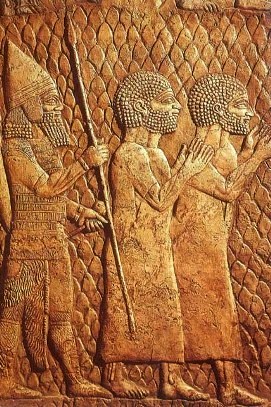
Assyrian sculpture of the capture of Lachish
In the Assyrian sculpture of the capture of Lachish (right), captured Jewish men are dressed in a moderately tight garment fitting closely at the neck (Job 30:18) and reaching almost to the ankles. They wear goose egg on their heads – these are a conquered people, at the mercy of their enemies.
Women are shown with a mantle like a long veil wrapped around the body and covering the forehead.
Clothes in Roman and New Testament times
Fashions changed petty later on Hellenistic times, but they acquired a Roman flavour.
The well-nigh interesting feature about Graeco-Roman habiliment of the first century AD was the manner in which a long piece of cloth, the "chlamys" as the Greeks called it, or the "pallium" in Latin, was draped over the tunic in a variety of means.
A special diverseness of the pallium was the "toga". The typical flowing garments of Roman citizens, with loose togas and stoles worn over them in various ways as a type of cloak, are shown on a Roman relief of 13 BC, portraying a religious procession (Ara Pacis).
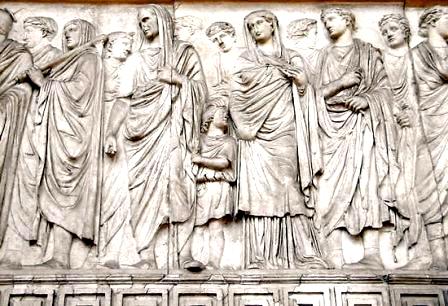
Function of the Ara Pacis, showing the Imperial family
Plain the emperor Augustus favored the austere toga every bit the quintessential Roman manner of dressing, which is why all members of the Augustan family are shown wearing togas – even, on other parts of this sculpture, small children.
Simply the ordinary Romans themselves did non like wearing the toga, because it was difficult to put on and inclined to autumn off unless one kept one's left arm bent upwards.
The wealthy and ruling classes in Palestine no doubt dressed like the patricians of Rome only the clothing of ordinary people — like Jesus and his disciples — was much simpler.
Plainly there were 6 garments :
- a linen shirt, haluk, worn underneath the tunic
- the tunic itself which might be "woven without seam" (John xix:23)
- a linen girdle wrapped around the waist (Matthew 3:4);
- leather sandals for the feet and
- an upper garment (Mark 9:3) probably fabricated of white wool, with tassels at the corners.
In those days, Jewish teachers covered their heads, so Jesus may have worn a white linen "napkin" sudarium like a turban. The sudarium was a kind of caput kerchief, and is mentioned as a covering for the heads of the dead (John xi:44; 20:7).

Draped upper tunic with loose trousers: condolement with way! 1st or 2nd century AD, from the Valley of the Tombs, Palmyra
What does the Bible say nearly apparel?
- Mixed materials in one slice of clothing forbidden, Deut. 22:11.
- Men forbidden to clothing women'due south clothes, women forbidden to wear men's clothes, Deut. 22:five.
- Rules with respect to women's clothes, 1 Tim. ii:9,ten; ane Pet. 3:3.
- Cloaks not to be held over night as a pledge for debt, Ex. 22:26.
- Ceremonial purification of, Lev. xi:32; thirteen:47-59; Num. 31:20.
-
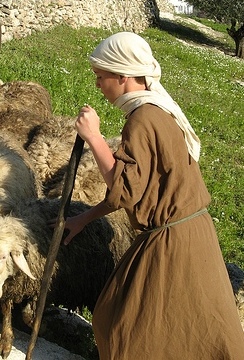 Various articles of clothing: Mantle, Ezra ix:3; i Kin. nineteen:13; 1 Chr. fifteen:27; Job 1:20; many colored, 2 Sam. thirteen:eighteen; purple, John xix:2,5. Robe, Ex. 28:4; 1 Sam. 18:4. Shawls, Isa. 3:22,
 - Embroidered glaze, Ex. 28:4,40; i Sam. 2:19; Dan. 3:21.
- Sleeveless shirt, Matt. 5:40; Luke 6:29; John xix:23; Acts 9:39.
- Cloak, 2 Tim. 4:13; John 19:2,v.
- Skirts, Ezek. 5:3.
- Mufflers, Isa. three:nineteen. Sashes, Isa. 3:20.
- Changes of raiment, the folly of excess, Job 27:16.
- Uniform vestments kept in store for worshipers of Baal, 2 Kings 10:22,23; Zeph. 1:8;
- for wedding feasts, Matt. 22:11.
- Presents fabricated of changes of dress, Gen. 45:22; 1 Sam. 18:4; ii Kin. v:5; Esth. 6:8; Dan. 5:7.
0 Response to "Ancient Jewish Fashion in the Time of David"
Post a Comment